Stick Duel: Medieval Wars
Medieval weapons, physics flailing, best-of duels.
 Loads instantly · Free · No install
About Stick Duel: Medieval Wars
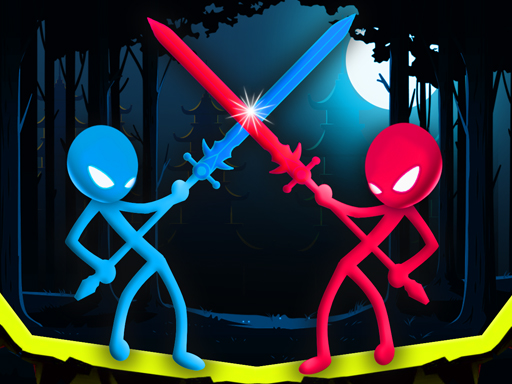
Stick Duel: Medieval Wars arms two stick knights with a rotating medieval arsenal — swords, spears, axes, the occasional surprise — and lets physics referee. Weapons swing with real momentum, so every duel becomes a dance of lunges, whiffs and perfectly timed pokes.
Rounds are fast and the weapon roulette keeps rematches fresh: mastering the spear says nothing about your axe game. A top-tier "settle it in five rounds" game.
How to play
Player 1 moves with A and D (and jumps), Player 2 mirrors on the arrow keys; your weapon swings with your movement. Control spacing — every weapon has a sweet-spot range — and take the round when your rival whiffs.
Controls
- Player 1 — A / D + jump
- Player 2 — Arrow keys
- Weapons rotate each round
Tips to win
- Learn each weapon's reach in round one; fight for that exact spacing after.
- Whiffed swings leave long recovery — that's your window, take it.
- High ground with a long weapon is nearly cheating. Claim it.
Stick Duel: Medieval Wars strategy guide
The weapon you are handed decides the round, so read it first. Stick Duel rotates weapons between rounds, and each one wants a completely different fight. Something with reach wants you holding distance and poking; something thrown wants you to aim and then reposition; something short wants you to close in fast before your opponent finds their range. Spending the first second of a round identifying what you are holding is worth more than any reflex.
On a shared keyboard, the player who panics loses. Player one works from A and D with a jump; player two uses the arrow keys. Both sets are small, which means neither player has an execution advantage and the entire contest comes down to decisions. Staying calm and making one deliberate move beats making three frantic ones, and against a flustered opponent patience wins almost by itself.
Jump to change position, not to dodge. Jumping in a duel game feels evasive but usually just makes you a predictable arc in the air with no ability to alter course. Jumps are useful for crossing a gap, getting onto higher ground or escaping a corner. If your reason for jumping is that you are being attacked, moving sideways along the ground is nearly always the better answer.
Corners are where duels are decided. Being backed up against the edge of the arena removes half of your options and doubles your opponent's. Notice where you are relative to the walls early in a round and make it a priority to fight from the middle. Equally, when your opponent has put themselves in a corner, that is the moment to commit rather than reset.
Play the series, not the round. These duels are short and streaky, and a single lost round means very little. Players who throw away their approach because they lost one exchange end up with no plan at all. Pick the tactic that suits the weapon, run it properly for a few rounds, and change it only when it has genuinely failed more than once.
Stick Duel: Medieval Wars FAQ
Is Stick Duel: Medieval Wars a 2 player game?
Yes. Two people share one keyboard — player one uses A and D with a jump, player two uses the arrow keys.